Is a Private Hiking Guide Worth It If You Can Hike on Your Own?
If you already hike, the question of hiring a private hiking guide can feel a little strange.
You may be active. You may be experienced. You may be perfectly capable of reading a trail description, carrying a pack, managing your own pace, and finding your way along a marked route.
So the question is honest.
Is a private hiking guide worth it if you can hike on your own?
Sometimes, no.
If you enjoy researching trails, making all the decisions yourself, adjusting the day as conditions change, and holding the full responsibility for how the hike unfolds, independent hiking may be exactly right for you.
But for some capable hikers, especially in an unfamiliar place like Banff, Kananaskis, Lake Louise, or the broader Canadian Rockies, the value of a private guide is not that you cannot find a trail.
It is that you do not have to carry every decision alone.
A private hiking guide may be worth it when you want the day to feel better matched, better paced, more spacious, and less mentally crowded by logistics, uncertainty, or second-guessing.
This is not about giving up independence.
It is about deciding how much of the day you want to hold yourself.
If you are still asking the broader question of whether guided hiking makes sense in Banff, Do You Need a Hiking Guide in Banff?i s a helpful companion article.
A Private Hiking Guide Is Not Just for Beginners
One of the common misunderstandings about guided hiking is that it is mainly for people who are inexperienced, nervous, or unable to hike on their own.
That can be true in some cases, but it is not the whole picture.
Many people who consider private guided hikes in the Canadian Rockies are already capable. They walk, hike, ski, cycle, travel, and spend time outside. They are not looking for someone to make them feel dependent. They are looking for someone who can help make one mountain day work well.
That distinction matters.
A private hiking guide is not there because you cannot walk a trail.
A guide is there to help match the route to the day, read the conditions, pace the experience intelligently, notice what is changing, and support the kind of mountain day you actually want to have.
For active adults over 50, this can be especially important.
Not because age makes someone less capable, but because many experienced people become more honest over time about what makes a day feel good. They may still want meaningful hiking, real terrain, and a satisfying mountain experience. They may also care more about pacing, descent comfort, recovery, weather, timing, crowd pressure, and not turning a beautiful day into something that feels unnecessarily hard.
If that feels familiar, Are Guided Hikes Right for Active Adults Over 50? may be a useful supporting article.
When Hiring a Hiking Guide May Not Be Worth It
A private hiking guide is not worth it for everyone.
If you love planning every part of the day, enjoy comparing routes, feel confident adjusting to weather and trail conditions, and prefer complete independence, you may not need a guide.
You may also be better off hiking on your own if you want full control over timing, pace, breaks, destination, and turnaround decisions.
For some hikers, that freedom is part of the pleasure.
You may not need to hire a hiking guide if you:
- enjoy researching and choosing your own trails
- are comfortable in unfamiliar mountain terrain
- understand how distance, elevation, weather, and descent affect your day
- are confident adjusting plans when conditions change
- prefer solitude or complete independence
- do not mind if the day becomes more uncertain than expected
- are looking for a casual outing rather than a supported private experience
There is nothing wrong with that.
Private guiding is not about persuading every capable hiker that they need support. It is about recognizing when professional judgment, route matching, pacing, and interpretation would make the experience better.
When a Private Hiking Guide Is Worth It
A private hiking guide is often worth it when the question is not, “Can I do this myself?”
The better question may be:
Do I want to spend one of my limited hiking days managing every decision myself?
In the Canadian Rockies, a hiking day is rarely shaped by one decision. It is shaped by many small ones.
Which region makes sense for the day? Banff or Kananaskis? Lake Louise or the Bow Valley Parkway? A famous trail or a quieter alternative? How early should you start? How hard will the descent feel? How much will elevation matter? Will heat, smoke, wind, crowding, parking, or weather change the experience? Is this the right hike for who you are today, not who you were ten years ago or who you imagine yourself to be on paper?
None of those questions is impossible to answer.
But together, they take energy.
A private hiking guide can be worth it because those decisions are not made casually. They are held by someone whose attention is on the route, the conditions, the timing, and the people walking the trail.
The value is often quiet.
It may not look dramatic from the outside.
But inside the day, it can change everything.
What You Are Really Paying For
At first glance, it may seem like you are paying a private guide to lead the way.
But if you are already a capable hiker, that is rarely the whole value.
You are paying for the judgment behind the day.
You are paying for the route not chosen because it would be too crowded, too exposed, too hot, too long for the available time, too hard on descent, or simply not right for the experience you want.
You are paying for pacing that protects the return before fatigue becomes obvious.
You are paying for timing that helps the day begin calmly rather than reactively.
You are paying for someone who notices weather, effort, rhythm, trail conditions, crowd pressure, and subtle changes before they become bigger problems.
You are paying for interpretation that helps the landscape become more than scenery.
You are paying for a day that feels coherent from beginning to end.
For many capable hikers, that is where the value becomes clear.
Not because the guide makes the day more impressive.
Because the guide helps the day fit.
Route Matching: Choosing the Right Hike, Not Just a Famous One
One of the clearest reasons a private hiking guide can be worth it is route matching.
Visitors often arrive in Banff or the Canadian Rockies with a list of hikes they have seen online. Some are famous. Some are beautiful. Some are heavily photographed. Some appear on nearly every “best hikes” list.
But the best-known hike is not always the right hike.
A trail can be spectacular and still be wrong for the day. It may be too crowded, too exposed to heat, too logistically complicated, too long for the available time, too demanding on descent, or simply not suited to the kind of experience you hoped to have.
A guide helps translate the question from:
“What is the best hike?”
to:
“What is the right hike for these guests, on this day, in these conditions?”
That is a very different question.
Route matching considers:
- your hiking background
- your natural pace
- available time
- current weather
- seasonal trail conditions
- access and parking pressure
- elevation gain
- descent difficulty
- exposure and footing
- crowd patterns
- how much energy you want to spend
- what kind of day would feel meaningful
This is where private guided hiking begins to separate itself from online research.
A list can tell you what is popular.
A guide helps you decide what fits.
If you are comparing possible routes, Best Hikes in Banff for Active Adults and Best Hikes in the Canadian Rockies can help you understand the range of possibilities. But the right choice for a private guided day depends on more than popularity.
Timing: Starting the Day Before It Starts to Unravel
Timing is one of the most underestimated parts of a mountain day.
A hike can be well within your ability and still feel harder than expected if the day starts too late, the trailhead is crowded, the heat builds early, weather develops, or the return takes more effort than planned.
In Banff and Kananaskis, timing is not just about getting an early start.
It is about understanding how the day is likely to unfold.
A private guide is thinking about questions such as:
- What is the weather pattern doing?
- How exposed is the trail?
- When does crowd pressure usually build?
- How long will the approach and return actually feel?
- Is the descent likely to slow the pace?
- Is there enough margin if the day changes?
- Is the objective appropriate for the available daylight and energy?
Good timing can make a day feel calm.
Poor timing can make a perfectly reasonable hike feel rushed, hot, crowded, or compressed.
That is one of the reasons guided hiking can be valuable even for experienced hikers. The benefit is not only having someone present on the trail. It is having the day shaped well before the first steps are taken.
Pacing: The Difference Between Capable and Well Matched
Many capable hikers underestimate pacing.
Not because they do not know how to walk, but because mountain terrain asks for a different kind of rhythm.
A person can be fit and still start too fast. A couple can both be strong and still move at different natural speeds. A hike can look moderate on paper and feel more demanding when elevation, heat, footing, descent, and travel fatigue are included.
Good pacing is not simply going slowly.
It is distributing effort intelligently.
It is knowing when to settle in, when to pause, when to shorten a stride, when to protect energy for the return, and when the day is asking for adjustment.
This is especially important for active adults over 50 who still want real hiking experiences, but do not want to be rushed, underestimated, or placed into a group pace that does not fit.
A private guided day allows the pace to reflect the actual people on the trail.
That is different from a group hike, where everyone is shaped by the shared rhythm of the group.
If pace is part of your concern, How to Pace a Hike in the Canadian Rockies, Travel Pace After 50 in the Canadian Rockies, and Am I Too Slow for Guided Hikes? are good companion reads.
Descent Management: The Part Many Hikers Forget to Plan For
Many hikers think mostly about the climb.
The descent often gets less attention.
But in the Canadian Rockies, descending can be one of the most demanding parts of the day. Knees, hips, balance, footing, loose surfaces, tired legs, and mental fatigue all matter more on the way down than many people expect.
A private hiking guide pays attention to how the whole day will feel, not just the destination.
That includes descent management.
This can mean choosing a route where the return will feel reasonable, pacing the climb so there is enough energy left, pausing before fatigue becomes sloppy, adjusting the objective if conditions make the descent less appealing, or simply helping the day avoid that common pattern where the summit or viewpoint feels wonderful but the return becomes a chore.
For capable hikers, this can be one of the most valuable parts of private guiding.
Not because the guide makes the descent easy.
Because the guide helps make sure the descent was considered from the beginning.
If you have ever finished a hike feeling that the way down took more out of you than expected, this is part of the value you are paying for.
Weather Judgment: Reading the Day in Context
Weather in the Canadian Rockies can change quickly.
Forecasts are useful, but they are not the whole story. Wind, cloud development, smoke, temperature, elevation, exposure, storm timing, and local terrain can all affect how a hiking day feels.
A private guide does not simply look at the forecast once and move on.
Weather is part of the ongoing decision-making process.
That might affect which region makes sense, how early to start, whether to choose a more sheltered route, how high to go, when to pause, whether to shorten the objective, or whether a different trail would make for a better day.
For visitors, weather can feel like background information until it becomes obvious.
For a guide, weather is part of the shape of the day from the beginning.
That is one of the reasons guided hiking can be worth it even when navigation is straightforward.
The value is not only knowing where the trail goes.
It is knowing how the day is changing while you are on it.
For more on this, How Hiking Guides Read Mountain Weather in the Rockies and What Hiking Guides Notice in the Canadian Rockies connect directly.
Crowd Avoidance Where Possible
Crowds are part of modern Banff and, increasingly, part of many well-known mountain areas.
A private hiking guide cannot make popular places empty.
But good planning can often reduce the impact of crowding.
Sometimes that means choosing a different start time. Sometimes it means choosing a different route. Sometimes it means avoiding an iconic trail on a day when the experience is likely to feel more crowded than meaningful. Sometimes it means accepting that a popular place will be busy, but shaping the day so it still feels worthwhile.
Crowd avoidance is not always about finding a secret trail.
Often, it is about making a better decision.
For capable hikers, this can be surprisingly valuable. You may not need help walking the trail, but you may appreciate help avoiding the version of the day that feels rushed, noisy, compressed, or more stressful than expected.
A private hiking guide helps protect the quality of the experience where possible.
That may mean choosing quiet over famous.
It may mean choosing fit over reputation.
It may mean choosing the day that works rather than the one that looked best online.
For context on crowding and access, Why Popular Hikes in Banff and Lake Louise Feel So Crowded and Overcrowding at Lake Louise: What It Changes in the Mountains are useful supporting articles.
Interpretation: More Than Reaching the Viewpoint
For many people, the value of a private hiking guide is not only practical.
It is also interpretive.
A guided hike can help you understand what you are moving through: the landforms, plants, wildlife patterns, glacial history, fire ecology, seasonal changes, human pressure, and the quieter relationships that shape the landscape.
Interpretation does not need to feel like a lecture.
At its best, it helps the place become more visible.
You begin to notice why one valley feels different from another. Why certain plants appear in one place and not another. Why wildlife movement matters. Why popular areas feel pressured. Why the mountains are not just scenery, but living systems shaped by time, weather, geology, animals, people, and change.
For capable hikers, this may be one of the most meaningful reasons to hire a hiking guide.
You may be able to walk the trail on your own.
But walking with someone who can help you see the landscape differently can change the experience.
If this side of the day matters to you, Wildlife Corridors in the Bow Valley and Tourism Pressure and Shared Responsibility in Crowded Parks Like Banff National Park offer helpful context.
Confidence Without Being Managed
Some people hesitate to hire a hiking guide because they do not want to feel managed.
That hesitation makes sense.
If you are used to hiking independently, you may not want a rigid experience, a fixed script, or a guide who treats you as if you are incapable.
Private guiding should not feel like that.
At its best, private guided hiking offers confidence without pressure.
You still get to move through the day as yourself. You still get to be capable, curious, and engaged. The difference is that the structure of the day is being held with you.
There is someone paying attention to the larger picture.
Someone thinking about timing, route, weather, effort, descent, crowd pressure, interpretation, and whether the day still fits.
That can create a quieter kind of confidence.
Not the confidence of proving something.
The confidence of knowing the day is being thoughtfully supported.
This is one reason private guiding can be such a good fit for people who are experienced enough to know that good judgment matters.
Less Decision Fatigue
Decision fatigue is one of the least visible reasons a private hiking guide can be worth it.
Before a hiking day even begins, visitors may be sorting through articles, apps, maps, weather forecasts, road reports, parking information, shuttle systems, trail descriptions, reviews, elevation profiles, and conflicting opinions.
By the time they arrive, they may have plenty of information but not much clarity.
That is common.
Information does not always reduce uncertainty. Sometimes it increases it.
A private guide helps narrow the field.
Instead of trying to decide from every possible hike in Banff, Kananaskis, Lake Louise, or the Canadian Rockies, the question becomes more focused:
What kind of day do you want?
What fits your ability, pace, time, and comfort?
What are the conditions doing?
What choice gives the day the best chance of feeling good?
For capable hikers, this can be a relief.
You are not paying because you cannot think for yourself.
You are paying so that the day is not consumed by decision-making.
That leaves more attention for the mountain itself.
Private Guided Hiking vs Group Hiking
If you are wondering whether a private hiking guide is worth it, it helps to separate private guiding from group hiking.
They are not the same experience.
A group hike can be a good fit for people who enjoy a shared structure, lower cost, a preset route, and a social day. But a group experience inevitably involves compromise. Pace, timing, breaks, interpretation, and energy all need to work for more than one person or one couple.
Private guided hiking is different.
The day is shaped around one or two guests.
That means the route can fit more closely. The pace can be adjusted naturally. Breaks can happen when they make sense. Interpretation can follow curiosity. The day can respond to the people who are actually there.
For active adults over 50, this distinction often matters.
Many people do not want to be placed into a group pace that is too fast, too slow, too rigid, or too socially demanding. They want a real hiking day, but they want it to fit.
If you are comparing these options, Private vs Group Guided Hikes: Which Is Right After 50? is the best supporting article.
Private Guided Hiking Is Not a Sightseeing Package
It is also important to be clear about what private guided hiking is not.
My private guided hiking service is focused on the hiking day itself. It is not designed as a packaged sightseeing tour, transportation service, restaurant-planning service, or full vacation itinerary.
For some visitors, that will not be the right fit.
If you want hotel pickup, multiple scenic stops, short walks, lake viewpoints, restaurant suggestions, and a broad travel day, a sightseeing tour may be a better choice.
Private guided hiking serves a different purpose.
It is for guests who want the hike itself to be the centre of the experience.
The value is in route choice, pacing, interpretation, field judgment, and a private day shaped around one or two people.
For the right guest, that focus is not a limitation.
It is the point.
If you want to understand exactly what is included, What’s Included in a Private Guided Hiking Day in Banff or Kananaskis? is the most practical next article.
When It Is Worth Hiring a Banff Private Hiking Guide
A Banff private hiking guide may be worth it if you have limited time, want to choose well, and care about how the day feels from beginning to end.
It may be especially worthwhile if:
- this is your first time hiking in Banff or the Canadian Rockies
- you only have one or two hiking days
- you are overwhelmed by online hike lists
- you are unsure which trail matches your pace
- you are traveling with someone who moves differently than you
- you want a quieter alternative to a group hike
- you want interpretation and local judgment
- you want help adjusting to weather, crowds, or conditions
- you are capable, but do not want to manage everything alone
This is not about needing to be rescued from uncertainty.
It is about choosing support where it actually improves the experience.
For many capable hikers, that is the honest answer.
A private hiking guide is worth it when the day matters enough that you want it shaped well.
When It May Not Be Worth It
A private hiking guide may not be worth it if your main goal is to keep the day casual, inexpensive, spontaneous, or completely self-directed.
It may also not be the right fit if you are mainly looking for transportation, a shuttle, a sightseeing itinerary, restaurant stops, or a multi-stop driving tour.
Private guiding is most valuable when the hike itself matters.
If the hike is just one small piece of a broader sightseeing day, another kind of tour may be better.
If the hiking day is the experience you care about most, private guiding may offer much more value.
This distinction is important because it helps you choose honestly.
The right choice is not always the most guided one.
The right choice is the one that fits the kind of day you actually want.
The Real Value Is a Calmer Day
The real value of a private hiking guide is often quieter than people expect.
It may not be the most dramatic view, the longest distance, or the hardest route.
It may be the feeling that the day made sense.
The route was right. The timing worked. The pace felt sustainable. The weather was watched. The descent was considered. The interpretation added depth. The decisions were made early enough that they did not become problems later.
The day did not feel overmanaged.
It felt well held.
For capable hikers, that can be deeply worthwhile.
Because the point was never that you could not hike on your own.
The point was that you wanted one mountain day to feel better matched, more meaningful, and less burdened by avoidable uncertainty.
That is when a private hiking guide is worth it.
How to Decide Whether Private Guided Hiking Is Right for You
A simple way to decide is to ask yourself these questions:
Do I want to research, choose, time, pace, adjust, and interpret the day myself?
Or would I rather have professional support so I can be more present inside the experience?
Do I want complete independence?
Or do I want a private day shaped around my pace, interests, comfort, and the actual conditions?
Do I want the freedom of doing everything myself?
Or do I want the confidence of knowing the day is being thoughtfully held?
There is no single right answer.
But if you are still reading, there is a good chance the question is not whether you are capable.
It may be whether you want this particular day to feel different.
What Happens Next
You do not need to know the exact hike before reaching out.
A better starting point is usually a conversation about your dates, where you are staying, your hiking background, your pace, and the kind of day you hope to have.
From there, it becomes easier to decide whether private guided hiking makes sense and what kind of route would fit.
You can explore:
Private Guided Hiking in Banff
Private Guided Hiking in Kananaskis
Custom Guided Hiking
How It Works
Expectations
If you are ready to begin, you can start a conversation.
Final Thought
So, is a private hiking guide worth it if you can hike on your own?
Sometimes no.
But if you are capable, self-aware, and visiting unfamiliar mountain terrain with limited time, the value of a private guide is not dependency.
It is fit.
A better route. Better timing. Better pacing. Better judgment. Better interpretation. Less decision fatigue. More confidence. A calmer day.
Not because you could not do it yourself.
Because you may want the day to be better than simply possible.
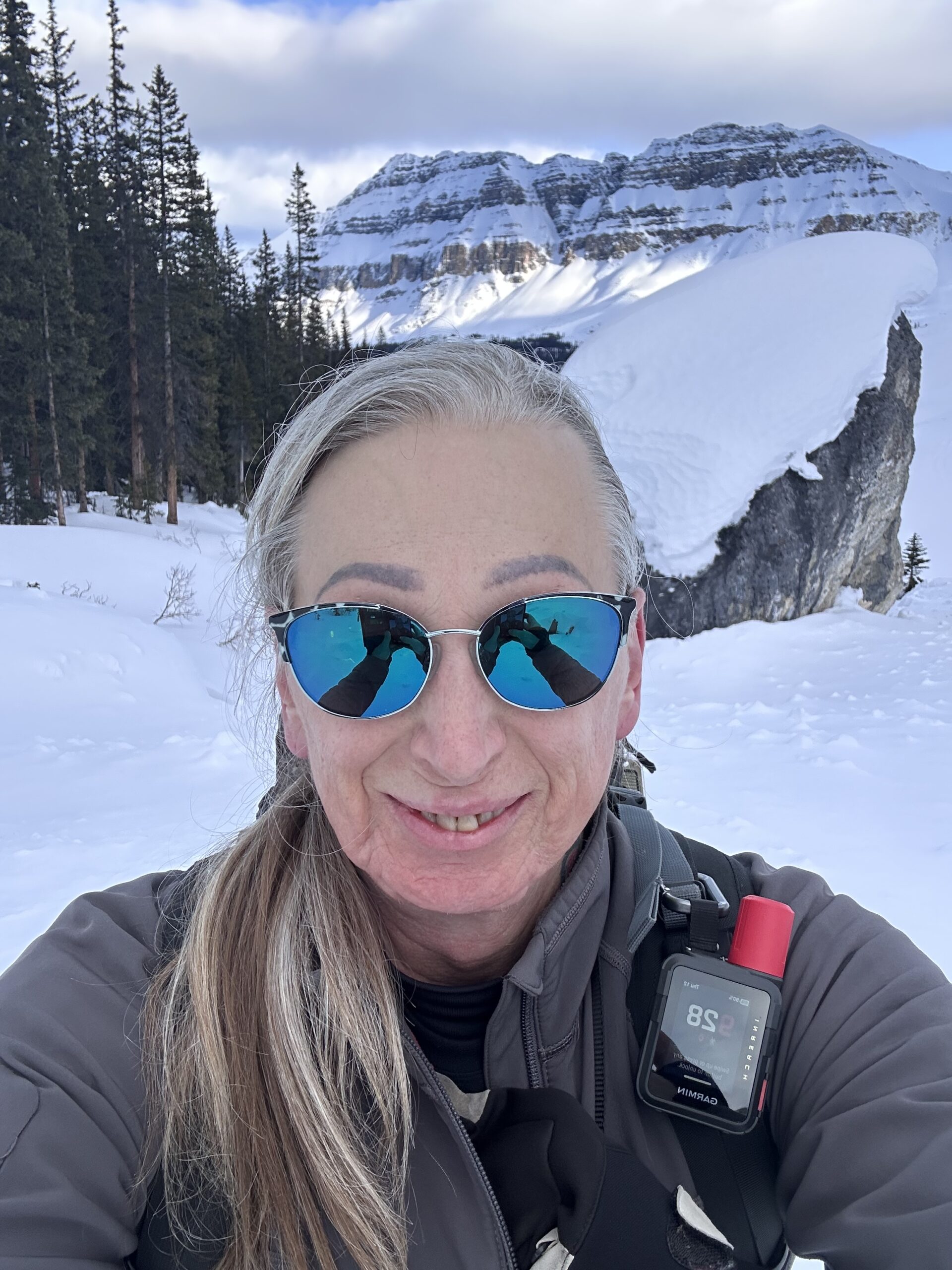
Certified private hiking guide and professional interpretive practitioner based in the Canadian Rockies. With over 25 years of four-season mountain experience, she offers thoughtfully paced hiking experiences that help active adults explore mountain landscapes with care, confidence, and understanding. Meet Niki